
Revenue growth management (RGM) in CPG: a practical guide for brands
The five pillars of RGM, the data each one needs, and where a brand selling through UNFI, KeHE, or DSD distributors can start without an RGM team.

By Christopher Kong / October 15, 2026 / 10 min read
Revenue growth management (RGM) is about growing the revenue and profit each sale brings in. Large CPG companies run it with dedicated teams, pricing models, and usually a consultancy or two. If you're a brand selling through UNFI, KeHE, or direct-store-delivery (DSD) distributors, you can start with the stores and products you already have.
Most guides to RGM are written for companies that already have an RGM department. I've written this one for brands that don't, which was me for most of my seven years running Better Nature.
We were the UK's number one tempeh brand by volume, and we still made RGM decisions the way most growing brands do: one promo at a time, in a spreadsheet, usually under pressure from a buyer's deadline. I didn't call it revenue growth management back then. I just knew some of our promotions were costing us money and I couldn't prove which ones.
What is revenue growth management (RGM) in CPG?
RGM is the practice of using data to decide price, promotions, pack sizes, assortment, and trade terms together, so each sale makes more money. The goal is to grow net revenue and margin as well as volume. Net revenue is what you keep after discounts and trade spend.
These decisions affect each other. A deep promotion can sell more cases and still lose you money, and a new pack size can take sales from your existing pack instead of adding new ones. When each decision sits with a different team, nobody sees the tradeoffs.
According to the pricing software company Buynomics, many companies have built RGM teams over the past two decades to bring these decisions together across sales, marketing, and finance. The person leading that work is often called a revenue manager or RGM manager, and they own the strategy across every lever.
You'll also come across net revenue management (NRM). Some firms, like Buynomics, use it as another name for RGM. Others, like the software company Infor, use it for a narrower part: what's left after discounts, trade spend, and other deductions.
The 5 pillars of RGM
The five pillars of RGM are pricing, trade promotion, price pack architecture, assortment and distribution, and trade terms. The list shifts a little depending on who's writing it. Simon-Kucher uses four levers, while Buynomics and o9 Solutions each use five, though not the same five. I've followed o9's list and widened assortment to include distribution, which Buynomics treats as its own lever ("distribution mix").
Pricing
Pricing is setting your shelf price, and the gap between your price and your competitors' prices, including store brands (private label). It decides how much each unit earns and how many units you sell.
Trade promotion
Trade promotion is the money you spend with a retailer for a temporary price cut, a display, or a spot in the store's ad. The decision is which promotions to run, in which stores, and whether each one paid back.
This is the pillar that hurt us most at Better Nature. We once ran a deep discount at one of the big UK grocers that moved a lot of packs. Once I'd added up the promo funding and the dip in the weeks after, we'd made almost nothing on it.
Price pack architecture
Price pack architecture is choosing which pack sizes and formats to sell, and at which prices. Think of a single can, a 4-pack, and a 12-pack, each priced so a shopper can trade up or down and still stay with your brand.
Assortment and distribution
Assortment and distribution is deciding which products go into which chains and stores, and then checking they get there. A product a chain has agreed to carry can still be missing from a lot of its stores. This pillar sits close to category management.
Trade terms
Trade terms are the financial agreements between you and your retailers and distributors. In o9's list they include listing fees, volume rebates, and promotional funding. They decide how much of the shelf price you keep.
RGM without a big data team
You don't need an RGM department to get started. You need the data you already receive, in one place.
Start by checking what you have. Most brands selling through distributors receive depletion reports (through VIP or from each distributor), UNFI and KeHE portal data, and sales data from some of their retailers. Distributor depletions are what a distributor sold to stores, which isn't the same as what you shipped to the distributor. If you aren't getting these reports yet, getting them is your first job.
Then I'd work through four steps:
- Put your data in one place, with one name per store. Every source names stores differently, so if the names don't match, a store that switches distributor looks like a lost customer.
- Start with assortment and distribution in chains you already sell to. Look for stores that carry some of your products but not your best sellers. You can start here because the data for it already arrives every week: which stores bought which products.
- Check each promotion after it runs. Compare depletions in the stores that ran it with the weeks before. It's a first read on whether the promo sold more, and it won't tell you on its own whether it made money.
- Leave pricing and pack architecture for later. These need data on the whole market and on how shoppers react to price changes, which usually means buying syndicated data and running price tests. That's where you may need a vendor or an analyst.
Those steps cover one pillar properly and give you a first read on a second. That's still RGM, and it's where a brand without a data team can realistically start. The same approach works outside sales too, which I wrote about in using AI in CPG operations without a data team.
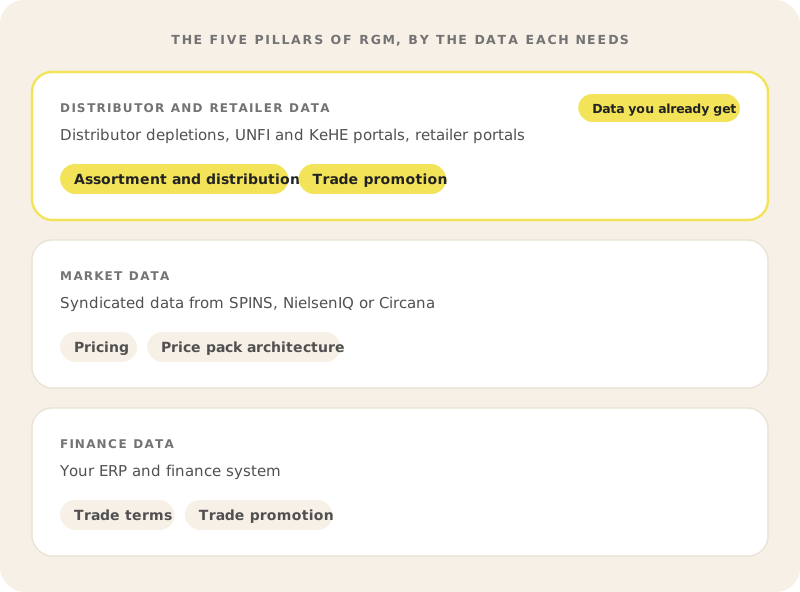
Two of the five pillars run on data a brand selling through distributors already gets.
What this looked like at CLEAN Cause
CLEAN Cause sells organic energy drinks through about thirty DSD distributors, the UNFI and KeHE warehouses, and retailers including Whole Foods and HEB. It doesn't have a dedicated data team. On Corvera, its eight data sources were connected and nearly 8,000 stores were matched across them, so each store has one record.
In August, the sales team dug into one of its larger accounts, a 150-store chain. Working by hand from portal exports, they found that only 2 of their 13 products were reaching the shelf. When they opened the Corvera dashboard, the gap was already flagged, along with the two best-selling products to pitch and the size of the opportunity. Jon Sowers, the VP of Sales, called the buyer, and adding more products to that chain is now on the table.
"We went digging ourselves, but Corvera already mapped out the action plan," Sowers said.
That's the assortment and distribution pillar, run without an RGM team. The same dashboard puts a dollar value on every risk and opportunity it finds. Working from CLEAN Cause's own distributor, portal, and retailer data, it showed $500K of sales at risk and $250K of immediate sales opportunities when the case study was published. You can read the full story in how CLEAN Cause found the gap.
Where the data comes from
This covers the data a US brand selling through distributors and retailers usually has. Your own online store, Amazon, and foodservice each have their own data, and I've left them out here.
| Source | What it tells you | Which pillars it feeds |
|---|---|---|
| Distributor depletions (VIP for DSD distributors, or direct) | What each distributor sold to each store | Assortment and distribution, trade promotion |
| Broadliner portals (UNFI, KeHE) | Orders and sales by warehouse and store, each on its own weekly schedule | Assortment and distribution, trade promotion |
| Retailer portals | Store-level sales in one chain | Assortment and distribution |
| Syndicated data (SPINS, NielsenIQ, Circana) | Category sales and market share across many retailers | Pricing, price pack architecture |
| Your ERP and finance system (for example, NetSuite) | Shipments, invoices, and trade spend paid | Trade terms, trade promotion |
Syndicated data is market data you buy from a vendor like SPINS, NielsenIQ, or Circana. It shows sales and share for a whole category, so you can see how your price compares. It's the main source a growing brand doesn't already get.
Getting the data is the easy part. Joining it is harder, because every source names stores differently and counts sales differently. As the CLEAN Cause case study puts it, a "sale" is "a shipped case in one system and a depleted unit in another." We built our AI sales agent for CPG brands for exactly this. It connects the feeds, matches every store, and flags gaps inside chains you already sell to.
FAQ
What are the 5 pillars of revenue growth management?
The five pillars of revenue growth management are pricing, trade promotion, price pack architecture, assortment and distribution, and trade terms. Some firms list four, and the names vary. Between them they cover how much you charge, what you spend on promotions, which packs you sell, where they're sold, and what you agree with retailers.
Is revenue growth management the same as net revenue management?
Often, yes. Many firms use net revenue management (NRM) as another name for RGM. Others use NRM for the narrower part that looks at what's left after discounts and trade spend.
What does an RGM manager do?
An RGM manager leads pricing, promotion, pack, and assortment decisions at a CPG company, and makes sure sales, marketing, and finance work from the same plan. The role exists at companies with an RGM department. Without one, the work falls to sales and finance.
Can a small CPG brand do revenue growth management?
Yes, in part. A brand selling through distributors can start with assortment and distribution, using the depletion and portal data it already receives. Pricing and pack architecture need market data and price tests, so they usually come later.
What data do you need for revenue growth management?
You need distributor depletions, broadliner portal data such as UNFI and KeHE, retailer portal data, and your own shipment and trade spend records. For pricing and pack decisions you'll also need syndicated market data from a vendor like SPINS, NielsenIQ, or Circana.
What is price pack architecture?
Price pack architecture is choosing which pack sizes and formats to sell, and at which prices. A brand might offer a single, a 4-pack, and a 12-pack, priced so shoppers can trade up or down without switching brands.
When you do need an RGM team or software
Some RGM work does need specialists. Price elasticity measures how much sales change when price changes, and estimating it takes statistical models built on store-level price and sales history. Pack architecture across many retailers, and testing several changes at once across hundreds of products, need the same kind of modeling. A dashboard built on distributor data won't do any of that.
o9 Solutions, which sells RGM planning software, puts it bluntly: "Organizations that have not moved beyond spreadsheet-based commercial planning are not doing RGM. They are doing commercial reporting." For a full RGM program, that's a fair point. I'd still argue that reading your own distributor data well is the first step toward one.
If you sell through many retailers with many pack sizes, change prices often, or spend heavily on trade, you may well need an RGM team. Software from SAP, o9, or Buynomics can help, and so can consultancies like BCG or Simon-Kucher. What tips it is how many prices, packs, and retailers you have to manage.
My advice is to start with the pillar your data already supports, which is assortment and distribution in the chains you sell to today. Put your distributor and portal data in one place, match each store to one record, and find the stores missing your best sellers. Add promotion checks after that, and leave pricing and pack work until you have market data. If you sell through distributors and this has sparked your interest, grab 30 minutes on my calendar and I'll show you what that looks like!
Sources
- Corvera, "CLEAN Cause runs and enhances its daily sales decisions on Corvera" (Christopher Kong, August 18, 2026)
- Buynomics, "Revenue Growth Management (RGM)"
- o9 Solutions, "What Is Revenue Growth Management? A Complete Guide"
- Simon-Kucher, "Unlocking potential with Revenue Growth Management"
- Infor, "What is Revenue Growth Management (RGM)?"
- Corvera, "The AI sales agent for CPG brands"
People also read
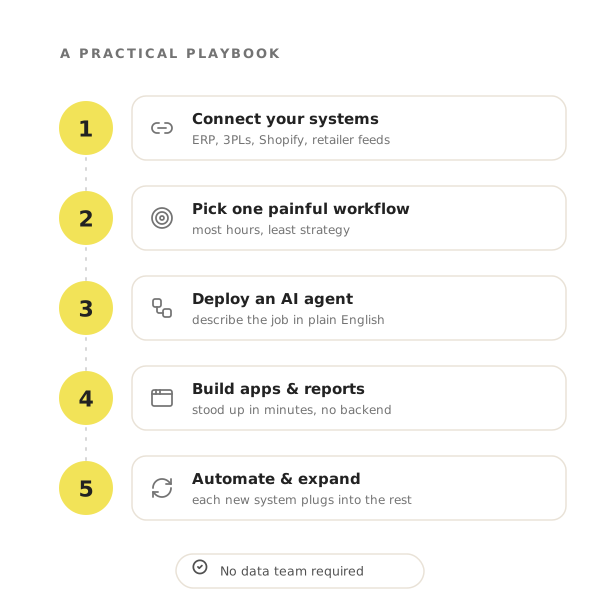
How to Use AI in CPG Operations Without a Data Team
You don't need a data team to use AI in CPG operations. A practical playbook: unify your data through a context layer, then deploy agents and automations.
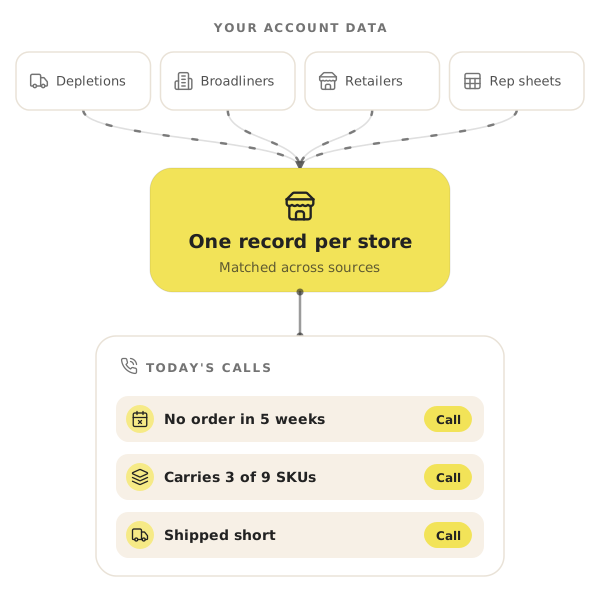
Sales intelligence platforms for CPG brands: a buyer's guide
A buyer's guide to sales intelligence platforms for CPG brands: prospecting databases vs. account signals, what to check in a demo, and eight questions to ask.
The AI sales agent for CPG brands
The AI sales agent for CPG brands. Sales intelligence on the accounts you sell to and a daily brief your reps act on, from distributor and retailer data.
Close distribution gaps on your core SKUs
Corvera checks every store against the core SKUs it should carry, ranks each gap by what it is worth, and drafts the ask for the rep, broker or buyer.
Category management for CPG brands
Run category management on unified sell-out, syndicated and distributor data. Corvera connects the sources you already have, so every category review starts from the full picture.
Christopher Kong · Co-Founder & CEO, Corvera
Chris is the Co-Founder and CEO of Corvera. He works closely with consumer brand operators on the numbers their businesses actually run on: sell-through, category performance, cash, and more. He writes about category management and cash flow for CPG operators.