
How to Use AI in CPG Operations Without a Data Team
A practical playbook for putting AI to work on orders, forecasting, and finance without hiring data engineers.

By Christopher Kong / June 7, 2026 / 4 min read
You don't need to hire data engineers or AI specialists to use AI in CPG operations. The blocker has never really been the AI. It's that your data sits in separate systems the AI can't read. Connect it once through a context layer, expose it to AI tools over MCP, and the operators you already have can run agents, build apps, and automate workflows in plain English.
Why most CPG brands stall on AI
When a brand decides to "do AI," the first instinct is to hire for it: a data engineer, maybe an AI specialist on top. Months later there's a pipeline project, a half-finished warehouse, and not much an operator can actually use.
The AI model is rarely the problem. The problem is that the data AI needs is stuck in places it can't reach:
- Inventory is split across several 3PLs, each with its own portal.
- Sales data lives in Shopify, Amazon Seller Central, and a stack of retailer feeds.
- The ERP, the forecasting tool, and the BI dashboard all disagree about the numbers.
No model can reason over data it can't see, so the work stays manual.
The shift: make your data readable, then let operators build
What works is making your data readable by AI once, so the people who already understand your operations can put AI to work themselves. That doesn't take a bigger AI team.
A context layer does exactly this. It connects to the systems you already run, matches them into one consistent set of records, and exposes those to any AI tool over MCP. After that, building with AI looks less like an engineering project and more like writing a clear instruction in plain English.
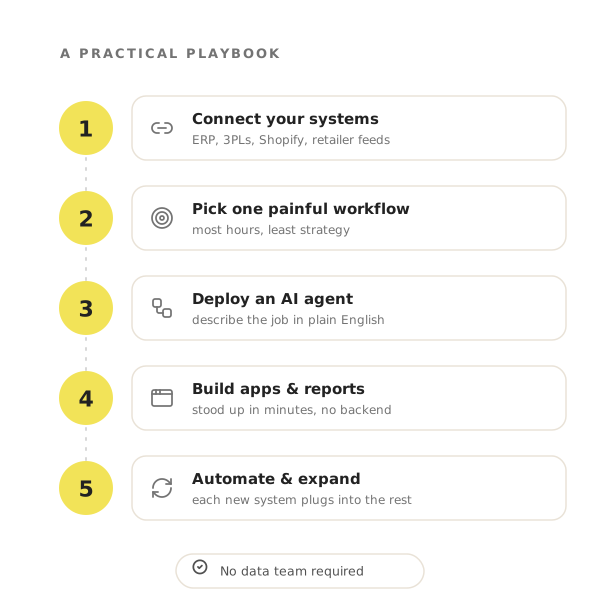
A practical playbook
1. Connect your systems
Plug in the tools you already use: your ERP (NetSuite, Cin7, Unleashed), 3PL portals, Shopify, Amazon, retailer feeds, and Snowflake. You don't replace anything or run a migration project. The context layer keeps everything in sync automatically.
2. Start with one painful, repetitive workflow
Don't try to fix everything at once. Pick the workflow that eats the most hours for the least strategic value. These are the usual first candidates:
- Unsold accounts. AI reads distributor depletions, flags the stores that stopped ordering, and drafts the follow-up for the rep.
- Inventory reconciliation. AI pulls stock on hand from your 3PLs and ERP into one view and flags where the numbers drift apart.
- Forecasting. AI rebuilds demand forecasts against live sell-through instead of last quarter's spreadsheet.
- Settlement reconciliation. AI works through Amazon and retailer settlement reports line by line.
3. Put an AI agent on it
In a tool like Claude or ChatGPT, point an agent at your matched data and describe the job in plain language. The agent reads live, permissioned data through the context layer, so it works against your real business and not a stale export.
4. Build the apps and dashboards your team needs
With tools like Cursor or Lovable, you can describe an internal report or tool in plain English and have it running in minutes. Your data is already readable, so there's no backend to build.
5. Automate and expand
Once one workflow is reliable, connect the next. Each new system you plug in, whether it's for category management, supply chain, or finance, is instantly available to every agent and app you've already built.
"But is it safe to let AI into our systems?"
It's the right question, and the answer is governance. A proper context layer is secure and auditable by default:
- You control exactly who in the business, and which AI tools, can see what.
- Every query and every action goes into a full audit log.
- Permissions live in one place instead of being scattered across a dozen brittle integrations.
What changes when this works
The brands doing this save more than the twenty hours, and the same pattern shows up each time:
- Order-to-cash cycles get shorter, because nothing sits in an inbox waiting for a person.
- Forecasts get more accurate, because the models run on live data.
- Operations and category teams get their time back and put it into work that grows the business, like new channels, retailer relationships, and product development.
That's how these teams grow revenue without adding headcount.
How Corvera helps
Corvera is the AI sales agent for CPG brands. It's built on a context layer so the operators who already run the business can put AI to work. We set it up with you and connect the systems you already use. From there Corvera matches them, controls who can see what, ranks what your sales team should do each day, and serves the same data to any AI tool over MCP.
Frequently asked questions
Do I need to hire data engineers to use AI in operations?
No. The bottleneck is data that AI can read, not headcount. A context layer handles the data side, so your existing operators can build with AI directly.
Where should a brand start?
Start with a single workflow that's high in volume and low in strategic value. Inventory reconciliation, forecasting, and retailer availability monitoring are the usual first wins.
How does setup work?
We set it up with you. We connect the systems you already use, map your stores and products together with your team, and run the first workflows on that data. You don't need a data team on your side.
Is it secure to let AI access our operational data?
Yes, when it runs through a layer with access controls and full audit logging. The AI only sees what you permit, and every action it takes is recorded.
If you sell through distributors and this has sparked your interest, grab 30 minutes on my calendar and I'll show you what that looks like!
People also read
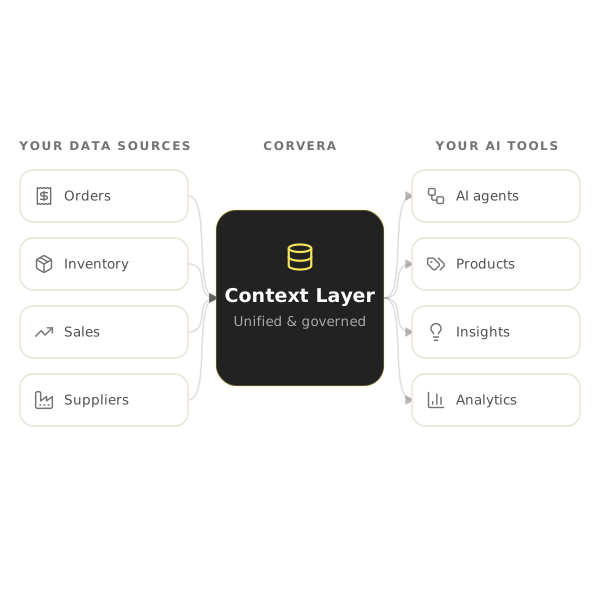
What Is a Context Layer for AI? A Guide for CPG Brands
A context layer connects your business data so AI tools can read it. Here's what that means for a CPG brand, and how it differs from a data warehouse.
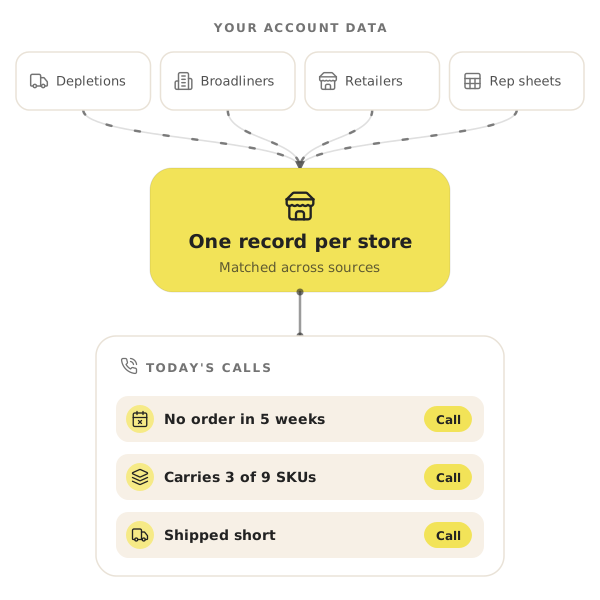
Sales intelligence platforms for CPG brands: a buyer's guide
A buyer's guide to sales intelligence platforms for CPG brands: prospecting databases vs. account signals, what to check in a demo, and eight questions to ask.
Christopher Kong · Co-Founder & CEO, Corvera
Chris is the Co-Founder and CEO of Corvera. Before that, Chris spent seven years building Better Nature to roughly 5,000 stores in six countries, closing every major sales deal along the way. Chris writes about selling through UNFI, KeHE and DSD distributors, and about category management.