
MCP for CPG Brands: How the Model Context Protocol Connects AI to Your Data
The open standard that lets AI tools read your business data securely, and what that means for a consumer brand.

By Christopher Kong / June 7, 2026 / 4 min read
MCP, the Model Context Protocol, is an open standard for connecting AI tools to data and systems. It gives any AI agent one consistent, secure way to plug into your business and read the context it needs. For a CPG brand, it's what lets tools like Claude and ChatGPT work directly with your orders, inventory, and sales data instead of guessing.
What is MCP?
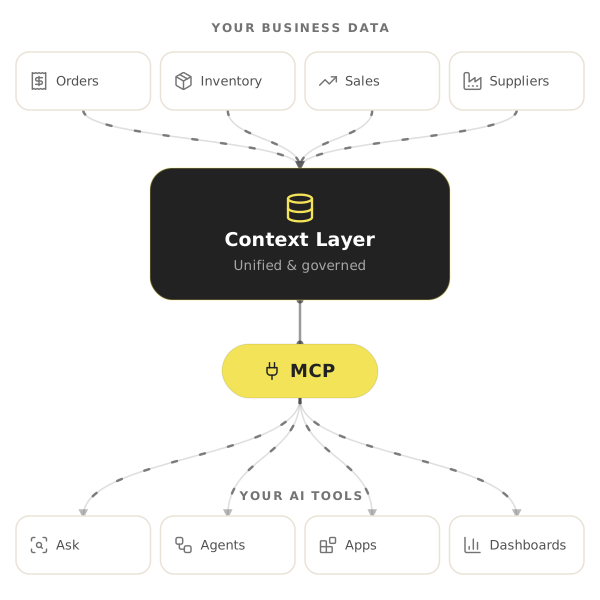
The Model Context Protocol is an open standard, first introduced by Anthropic, that defines how AI applications connect to outside data sources and tools. Before MCP, every AI tool needed its own integration for every system it wanted to reach. MCP replaces all of those with one common protocol.
An MCP server exposes data and capabilities, like "read sales orders" or "look up stock on hand." An MCP client is an AI tool such as Claude, ChatGPT, or Cursor, and it connects to that server to call those capabilities securely when it needs them. Because the protocol is standard, any client can talk to any server.
People often call it USB-C for AI. Every device used to need its own cable, and now one connector works everywhere.
Why MCP matters for CPG brands
A CPG brand runs on a sprawl of systems: an ERP, one or more 3PLs, Shopify, Amazon Seller Central, retailer data portals, and BI. The data exists, but it's siloed, and AI tools can't see it.
Without a standard like MCP, putting AI to work means building and maintaining a custom connector for every pairing of tool and system. That's the N×M integration problem. Five AI tools and six systems add up to thirty brittle integrations.
MCP cuts that down. You expose your business over MCP once, and any MCP-compatible AI tool can read it, including tools that don't exist yet. So you aren't betting on one vendor's assistant, because your data is open to every tool that speaks the protocol.
What AI can do with your data over MCP
Once your data is exposed over MCP, AI tools can do real work against live data instead of stale exports. They can:
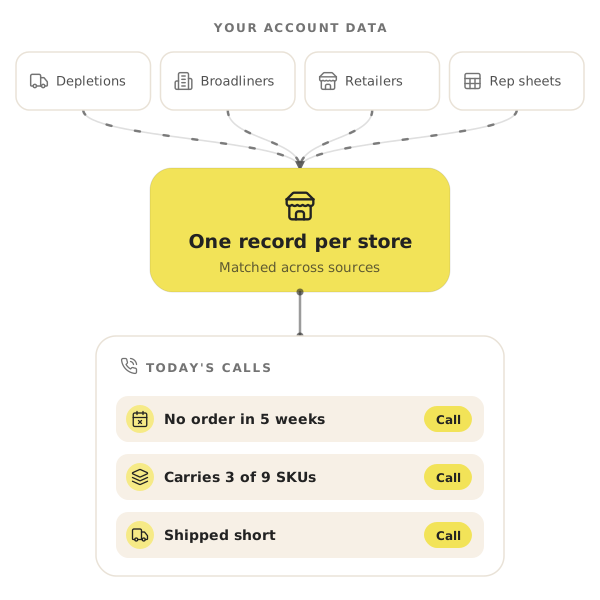
- Rank the accounts to call from distributor and retailer data: the stores slowing or no longer ordering, the core SKUs a store doesn't carry, and the orders a distributor shipped short.
- Answer questions in plain English, such as "what are our share, velocity, and distribution at this retailer?", by reading your retailer, distributor, and syndicated data.
- Monitor retailer availability across your retailer portals and flag out-of-stocks before they cost you sales.
- Draft the rep brief, the buyer email, and the distributor follow-up for each account.
- Trigger actions in your systems when you grant permission, like creating orders, updating records, or flagging exceptions.
Is MCP secure?
MCP itself is just a protocol, so security depends on how the server is built. A well-built MCP layer for a business should give you:
- Access control, with fine-grained permissions over who, and which tools, can see or do what.
- An audit log of every query and action, so nothing happens out of sight.
- One place to govern what's exposed, instead of credentials scattered across a dozen one-off integrations.
That's why I don't think most brands should build their own MCP servers against raw production systems. The protocol is the easy part. The hard part is doing it securely and with the right business meaning behind the data.
How to expose your CPG data over MCP
You have two broad options.
- Build it yourself. You stand up MCP servers against each of your systems, normalize the data, and add permissions and audit logging. It works, but it's a real engineering project to build and an ongoing one to maintain as your systems change.
- Use a context layer. A context layer connects to your systems, matches the data into one consistent model, and serves it over MCP with governance built in, so you don't do any MCP engineering per system.
For most brands, the second option is the difference between an AI plan that ships and one that turns into a permanent internal project.
How Corvera uses MCP
Corvera is the AI sales agent for CPG brands, and it's built on a context layer. We connect the systems you already use with you (NetSuite, Cin7, Unleashed, Shopify, Amazon, Snowflake, and more). Corvera then matches them into one set of records and serves those to any AI tool over MCP. You bring the AI agents and assistants you prefer, and they all read from the same secure context. Every query and action is access-controlled and audit-logged by default.
An AI tool only knows the data you give it, and your own data only shows the stores that already buy from you. We add what it can't see: the UNFI and KeHE stores that don't carry you yet, and the buyer at each one.
Frequently asked questions
What does MCP stand for?
MCP stands for Model Context Protocol, an open standard for connecting AI tools to data and systems.
Do I need MCP to use AI in my brand?
Not strictly. But without a standard like MCP, you're back to building a custom integration for every tool. MCP is what lets AI reach your data at scale, whichever tool you pick.
Can any AI tool use MCP?
Any MCP-compatible client can. Most major AI assistants and developer tools support it now, and the list is growing fast.
Is exposing my data over MCP safe?
It's as safe as the layer serving it. A context layer with access control and full audit logging means AI only sees what you allow, and you can see everything it did.
If you sell through distributors and this has sparked your interest, grab 30 minutes on my calendar and I'll show you what that looks like!
People also read
What Is a Context Layer for AI? A Guide for CPG Brands
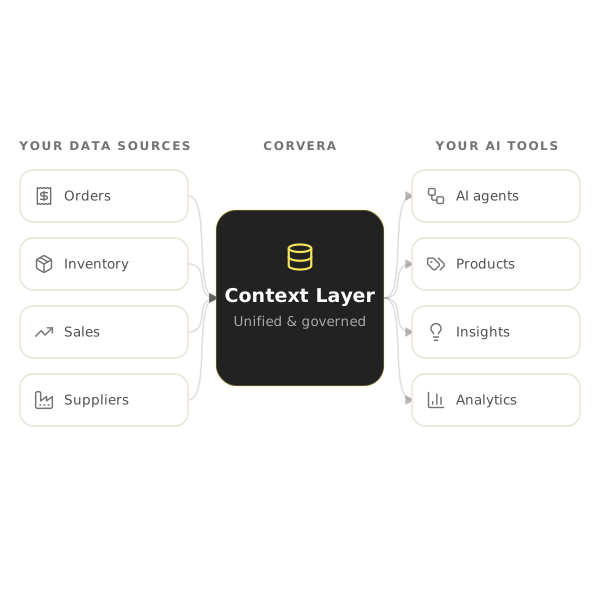
A context layer connects your business data so AI tools can read it. Here's what that means for a CPG brand, and how it differs from a data warehouse.
Sales intelligence platforms for CPG brands: a buyer's guide
A buyer's guide to sales intelligence platforms for CPG brands: prospecting databases vs. account signals, what to check in a demo, and eight questions to ask.
The AI sales agent for CPG brands
Corvera is the AI sales agent for CPG brands. It turns your distributor and retailer data into sales intelligence on the accounts you sell to and a daily brief your reps act on.
The Corvera platform
How the AI sales agent and the context layer under it fit together.
Christopher Kong · Co-Founder & CEO, Corvera
Chris is the Co-Founder and CEO of Corvera. Before that, Chris spent seven years building Better Nature to roughly 5,000 stores in six countries, closing every major sales deal along the way. Chris writes about selling through UNFI, KeHE and DSD distributors, and about category management.