
What Is a Context Layer for AI? A Guide for CPG Brands
Why AI tools can't answer questions about your stores yet, and what fixes that.

By Christopher Kong / June 7, 2026 / 4 min read
A context layer connects the systems you already run, matches the same store and product across all of them, and lets AI tools read the result. Without one, every AI tool needs its own connection to every system. For a CPG brand, it's what lets an AI tool answer a question like "which of my stores stopped ordering this month?" from your distributor, retailer and ERP data.
What a context layer actually is
Every CPG brand already has data. It's just spread across a dozen systems that don't talk to each other, each with its own format, login and quirks.
A context layer sits between those systems and the AI tools you want to use. It connects to what you already run: your ERP, 3PL portal, ecommerce and marketplace accounts, retailer feeds and BI tools. It matches the data inside them to one model, so "an order" or "a SKU" means the same thing in every report. And it lets any AI tool read that data through one secure connection, usually over MCP, the Model Context Protocol.
You end up with one place for AI to read your business from, and to act on when you let it.
Why does AI need context to be useful?
ChatGPT and Claude are very good at reasoning, but they know nothing about your business. Ask either one "which of my stores stopped ordering this month?" and it can't tell you, because it has never seen your distributor data.
You can paste a spreadsheet into a prompt, but it's out of date by the next morning and the AI can't do anything with it. So most teams try building a connection from each AI tool to each system, and that's where it falls apart. Five tools and six systems means thirty connections to build and keep working. Each one handles permissions its own way, and when a portal changes its export, every connection that reads it breaks.
A context layer turns those thirty connections into eleven. Each system connects to it once and each AI tool reads from it once, which means a new tool can see everything on its first day.
How is a context layer different from a data warehouse?
These get mixed up a lot. A data warehouse like Snowflake or BigQuery stores data for analysts to query with SQL. It's built for people writing reports, not for an AI tool that needs to read and act on your data every day. A context layer often sits on top of a warehouse, and plenty of brands never need to set one up at all.
An integration tool like Celigo or Zapier moves data from one system to another on a schedule. That's useful, but it won't match the same store across three reports, and it gives an AI tool nothing to reason over.
A context layer does the two things those tools skip. It matches your data into one model, and it lets AI read that model, with permissions and an audit log built in.
Why does this matter for CPG brands?
CPG data is unusually scattered. One brand might sell through its own site, Amazon, grocery, convenience and international distributors, and each channel has its own portal, format and rules. Behind that sit an ERP, one or more 3PLs and the retailer feeds.
That's why so much CPG sales work is still done by hand. Someone pulls share, velocity and distribution into a spreadsheet the week before a category review. Someone builds the non-buy list at month end, weeks after the stores stopped ordering.
Of course I'm biased, but I don't think the model was ever the hard part. Getting the data into shape is, and it takes a context layer that understands distributor depletions, retailer portal data and the quirks of each retailer.
What can you do once you have one?
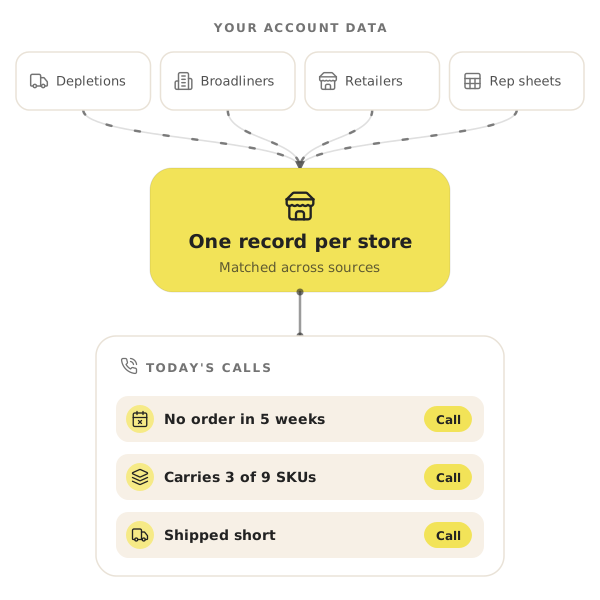
Once your data is matched and readable, anyone in the business can put AI to work without a data engineering project. The use I care most about is sales: ranking the accounts to call today from your distributor and retailer data, like the stores that stopped ordering and the core SKUs a store doesn't carry, with the ask written for each one.
You can also run AI agents in Claude or ChatGPT that watch velocity, non-buys and short shipments, then draft the rep brief, the buyer email and the distributor follow-up. And you can build internal dashboards in plain English with tools like Cursor and Lovable.
You still decide who in the business (and which AI tools) can see what, and every query and action goes in an audit log.
How Corvera fits
Corvera is the AI sales agent for CPG brands, and it's built on a context layer. We connect the systems you already use with you (NetSuite, Cin7, Unleashed, Shopify, Amazon, Snowflake, and the rest). From there Corvera matches them, ranks what your sales team should do each day, and serves the same records to any AI tool over MCP. There's nothing to rip out.
Your own data only shows the stores that already buy from you. We add what it can't: the UNFI and KeHE stores that don't carry you yet, and the buyer at each one.
Frequently asked questions
Is a context layer the same as a data warehouse?
No. A warehouse stores data for analysts to query. A context layer matches your data into one model and lets AI tools read and act on it. It often sits on top of a warehouse, and sometimes it means you don't need one.
Do I need to replace my existing systems?
No. A context layer connects to the systems you already use and leaves them where they are, so there's no migration.
How does AI read the context layer?
Usually over MCP (the Model Context Protocol), a standard that lets any compatible AI tool read the data it's allowed to see.
If you sell through distributors and this has sparked your interest, grab 30 minutes on my calendar and I'll show you what that looks like!
People also read
Christopher Kong · Co-Founder & CEO, Corvera
Chris is the Co-Founder and CEO of Corvera. Before that, Chris spent seven years building Better Nature to roughly 5,000 stores in six countries, closing every major sales deal along the way. Chris writes about selling through UNFI, KeHE and DSD distributors, and about category management.